MASTERBATCH ESSENTIAL GUIDE
What Is Masterbatch and What Does It Do in Plastics?
Masterbatch is a concentrated granular material that combines pigment or additives with a carrier polymer to deliver controlled color, cleaner dosing, and repeatable quality in plastic production.
Color Masterbatch Technical Team · 2026-08-12 · 4 min
Masterbatch Structure and Working Principle
Masterbatch is produced by dispersing pigment or a functional additive at high concentration in a compatible carrier polymer. The granules are metered into the base resin during processing, creating a cleaner and more controllable alternative to direct powder handling.
Pigment and carrier compatibility
Color strength depends on more than pigment loading. Compatibility between the carrier and PE, PP, PVC, PS, EVA, ABS, or another base polymer affects melting, dispersion, surface appearance, and process stability.
Why granular form matters
Granules support accurate dosing, reduce airborne dust, and make an approved formula easier to repeat between batches. Granule size, flow behavior, and feeding equipment still need to match the production line.
What Does Masterbatch Do in Production?
Color masterbatch transfers a target shade to the plastic product, while additive masterbatch can support requirements such as UV resistance or antistatic behavior. The result must be assessed together with resin, temperature, machine type, and dosage.
Color and surface consistency
Good dispersion helps limit shade fluctuation across a part, film, or profile. RAL, Pantone, and physical samples are starting references; final approval should be made in the actual polymer under representative process conditions.
Process and quality control
Homogeneous mixing, stable feeding, and an appropriate temperature window support repeatable color. Keeping laboratory samples, line feedback, and physical checks in one traceable record makes repeat orders safer.
How to Select the Right Masterbatch
One masterbatch does not perform identically in every polymer or machine. Selection should combine shade, base resin, production method, end-use environment, surface target, and applicable regulatory or sector requirements.
Technical data to share
Provide resin type, process and machine, temperature range, target dosage, wall thickness, end use, annual demand, and any approved or rejected samples. Complete data reduces unnecessary trial cycles.
From laboratory sample to production
After laboratory approval, a controlled line trial should confirm the recipe. Color tolerance, dosage, and machine parameters are then recorded so the approved result can be reproduced in serial production.
Request a technical review and sample for a masterbatch matched to your resin and production process.
Related guides
- MasterARM product page
- MasterMIC product page
- MasterKEM product page
- Masterbatch Dosage Rate and Calculation Guide
- Choosing Color Masterbatch: RAL, Pantone, and Sample Matching
- What Causes Color Variation in Plastics? Troubleshooting Guide
Sources
How Is Masterbatch Made?
A typical process combines suitable pigments or additives with a carrier polymer, mixes and disperses them in the melt, then forms granules. Production methods vary by product.
Quality checks and line trials
Colour, dispersion and processing compatibility are evaluated. Validate the sample with the intended raw material on the actual production line.
Masterbatch Types and Selection
Colour masterbatch targets a shade; white and black grades address whiteness, opacity or blackness. Additive masterbatch carries functional additives for the application.
A product name is not enough
Check the carrier polymer, processing temperature, end use and applicable documents together. Not every colour or additive suits every polymer; use the supplier’s technical data sheet and sample results.
How Is Masterbatch Dosage Calculated?
First establish the mass basis. At an illustrative dosage of 2% of the final blend, a 100 kg blend contains 2 kg masterbatch and 98 kg base material.
Adding to 100 kg of base material is different
Adding 2 kg to 100 kg of base material gives 102 kg total: 2 / 102 × 100 = approximately 1.96%. These are calculation examples, not dosage recommendations. Confirm the suitable rate using the technical data sheet and line trials.
The technical basis of masterbatch selection
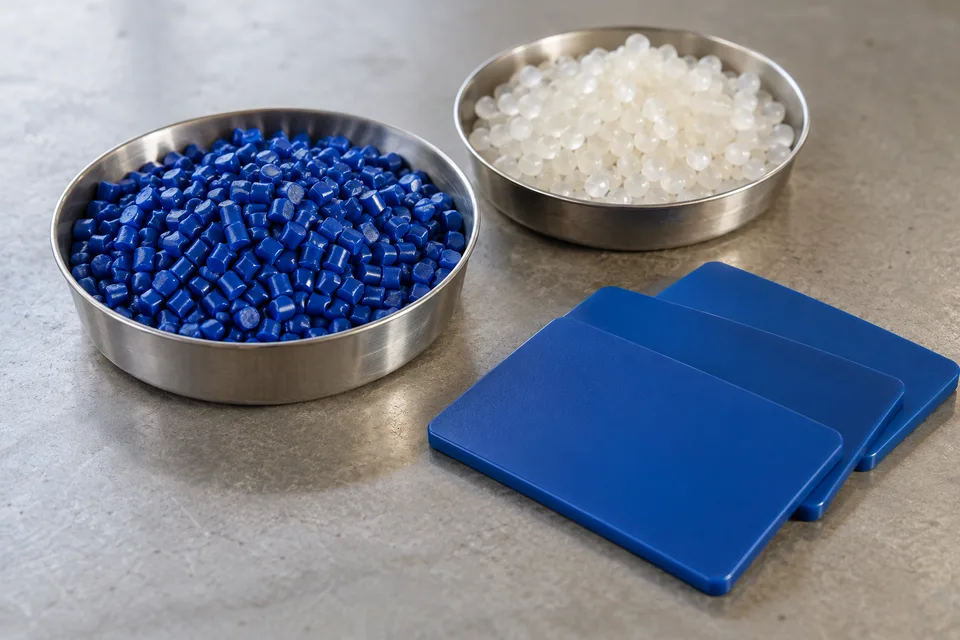
Masterbatch is a pigment or additive concentrate in a polymer.
Technical source: Coperion · Masterbatch
Why does the carrier matter?
Ampacet explains carrier viscosity and dispersion for pressurised HDPE pipe. That scope does not establish PVC suitability.
Technical source: Ampacet · Designing High Performance Pipe Compounds
Specify your polymer grade, process and part conditions; evaluate final suitability through a sample trial.
General technical explanation, not a Color Masterbatch technical datasheet, test result or conformity certificate.